
Applications / Thermal management
Galvorn® moves heat with less mass.
For thermal management, Galvorn lets you design where heat goes. Annealed film moves heat far more readily along its length than through its thickness, so one layer can carry heat toward a sink while limiting how much couples into the parts around it. Single-filament Galvorn conducts heat better than copper at a fraction of the weight, and the material bends like a textile, so heat paths can follow complex shapes.
Context
What materials are used for thermal management?
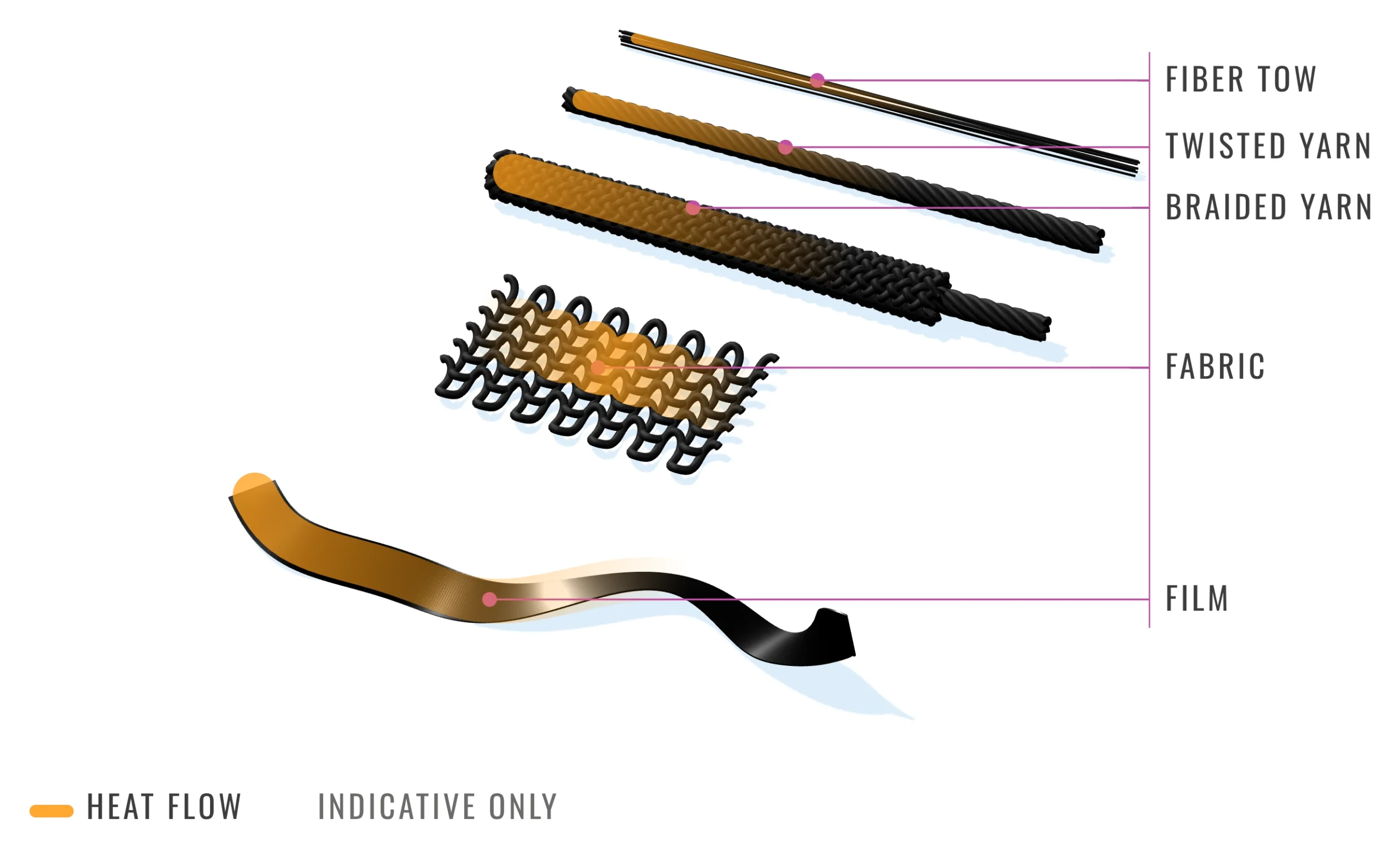
Thermal management is the control of where heat goes in a device or vehicle: pulling it away from the components that make it and routing it to where it can be shed. The materials that do this work, such as copper, aluminum, and graphite sheet, are chosen for thermal conductivity, then weighed against mass, stiffness, and the space they take. Galvorn® is an advanced carbon material that conducts heat and electricity, weighs less than copper or aluminum, and bends like a textile, so engineers can route heat through shapes and joints that metal and graphite sheet cannot. DexMat supplies it as film, fiber tow, twisted yarn, braided yarn, and fabric.
The problem
Metal heat paths add mass at every joint and bend.
Copper and aluminum move heat, but they add mass at every joint, bend, and mounting point. Graphite sheets and carbon fibers are lighter, but they limit how far a heat path can bend. A path that crosses a hinge, an articulating arm, a vibrating bracket, or a crowded board ends up as a compromise between added mass and thermal performance.
Weight and space decide the design on satellites, launch vehicles, aircraft, UAVs, eVTOL aircraft, and defense systems, and in tightly packed electronics and data center cooling hardware. The same trade-off shows up in heat exchanger and industrial heating development and in composite parts. A separate electrical or shielding layer often runs beside the heat path and adds more parts and more weight.
Properties
One material that ends the trade-off.
Top-line figures are for Galvorn fiber. Figures by product form are in the table below and on the data sheet.
By form
What each form delivers for thermal management
Thermal conductivity measures how well a material moves heat along a path, in watts per meter per kelvin (W/m-K). With Galvorn, it depends on the form you choose and on the direction you measure. Per unit volume, only a single filament beats copper, and pyrolytic graphite sheet is higher still in the plane. Per unit mass, Galvorn® 800 Twisted Yarn moves more heat than copper: 83 W/m-K at a yarn density of 0.81 g/cm³ against 385 W/m-K at 9.0 g/cm³ for copper, about 2.4x the thermal conductivity per gram. What copper and graphite do not offer is the rest of the combination: a flexible heat path, through-thickness isolation in film, and an electrical path in the same material.
| Form or material | Thermal conductivity (W/m-K) | Note |
|---|---|---|
| Galvorn single filament | 450 | Single filament |
| Annealed film, along the alignment | about 270 | Film produced by DexMat, annealed at 800 to 900 °C, published 2026 study |
| Annealed film, across the alignment, in the plane | about 35 | Same study and anneal |
| Annealed film, through the thickness | about 0.2 | Same study and anneal |
| Galvorn® 800 Twisted Yarn, 400 micron | 83 ± 6 | Measured, 2026 |
| Copper | 385 | Comparison |
| Aluminum | 237 | Comparison |
| Pyrolytic graphite sheet | 700 to 1,950, in plane | Comparison; supplier data sheet values |
Film values are from a 2026 study published in Nano Letters, measured on film produced by DexMat and annealed at 800 to 900 °C. The single-filament value is from DexMat characterization, and the yarn value is a 2026 measurement.
Film
Spread heat along the film and limit what reaches its neighbors.
Galvorn film moves heat mainly in the direction its fibers run. In a published study, annealed film carried heat about 1,400 times better along its length than through its thickness, a ratio the researchers report as the highest measured at room temperature for any material class. Use it to pull heat from a hot spot to a cooler edge or a heat sink, and to limit heat coupling between neighboring components, with a layer about 20 microns thick. Galvorn film also conducts electricity, so the same layer can serve as an electrical path.

Moving joints
One flexible material across a moving joint.
Heat paths on spacecraft mechanisms, aircraft actuators, robotic arms, and hinged electronics cross joints that bend over and over. Galvorn handles like a textile and has about 1,000x the flex life of copper, so a heat path can move with the joint. Galvorn also conducts electricity, so one path can carry power or signal alongside the heat.
Operating temperature
Specify annealed Galvorn if your design runs hot.
As-produced Galvorn loses some electrical conductivity when it is first heated, because heat drives off the dopant; how much depends on the temperature and the time held there. Annealed Galvorn, available as an add-on to any store order, has already had the dopant removed. The yarn also keeps its strength across temperature swings: in thermal shock testing between -65 °C and 150 °C, Galvorn twisted yarns held their break force within 6% below to 8% above their starting values across nine constructions and treatments. In the same thermal cycling, ETFE-insulated Galvorn yarn kept about 94% of its conductivity, one sample. Talk to our engineers about your thermal requirements and which annealed material fits.
Heat exchangers
Textile heat exchangers are in development.
Plate-fin heat exchangers commonly use aluminum or copper fins. Single-filament Galvorn conducts heat 17% better than copper, and it can be woven and knitted into textiles. Designers can build heat exchange structures in more complex shapes than metal fins allow, taking advantage of higher surface area. In 2024 the U.S. Department of Energy awarded $1.5 million to a joint DexMat and Rice University project to raise the thermal conductivity of Galvorn fibers for heat exchange, as a first step toward replacing metal fins.
"The high thermal conductivity and high specific surface area make Galvorn products appealing for heat exchange applications," said Geoff Wehmeyer, Assistant Professor of Mechanical Engineering at Rice University.
Heating
A fiber that carries current can also be the heater.
Galvorn conducts electricity, so a fiber or a fabric heats when current passes through it. In a 2026 study in the journal Small, Rice University researchers built immersion heaters from DexMat's fiber, as single filaments, parallel arrays, and fabrics. The fiber heaters delivered more heating power per unit of mass than comparable metal-alloy elements before failing, with the largest advantage in atmospheres without oxygen. The fabrics heated more evenly than rigid metal mesh, with fewer hot spots.
The work targets the electrification of industrial gas heating. "Their high thermal conductivity helps distribute heat and suppress localized hot spots," said Wehmeyer.
Harvesting
A fiber that turns a temperature difference into power.
Galvorn generates a voltage across a temperature difference; how much per degree depends on the anneal condition and is not a fixed production spec. Tokai Rika, a Tier 1 automotive supplier, used that property to build a flexible thermoelectric generator with Galvorn that bends 180 degrees and mounts on remote heat sources.
Forms
Material from DexMat, heat paths from your team.
Galvorn is supplied as film, fiber tow, twisted yarn, braided yarn, and fabric, and annealing is available as an add-on. Film suits heat spreaders and straps. Tow and yarn suit flexible conductors and heating elements. Fabric suits composite plies, heating fabric, and woven or knitted heat exchange structures. In a composite layup, a conductive ply or film layer can carry heat through the part without adding metal mass; structural reinforcement, conductive layers, and integrated sensing are covered on the Multifunctional Composites page. Customers build the heat spreaders, straps, heaters, and heat exchangers on their own equipment. DexMat supplies the material and works with your team on how to use it.
FAQ
Questions engineers ask about Galvorn for thermal management.
It depends on the form and the direction. A single Galvorn filament measures 450 W/m-K at best, against 385 for copper. Galvorn® 800 Twisted Yarn at 400 micron measures 83 ± 6 W/m-K, which is about 2.4x the heat per gram of copper once the yarn's density of 0.81 g/cm³ is counted. Annealed film from a published study (film produced by DexMat, annealed at 800 to 900 °C) measures about 270 W/m-K along its alignment and about 0.2 through its thickness. The right form depends on your design, so talk to our engineers about your requirements.
Start with a sample.
Order Galvorn film, fiber tow, yarn, or fabric samples from the store, add annealing for heated service, or tell our engineers which heat path you need to move.