
Applications / Advanced textiles
Galvorn® yarn makes textiles that conduct, sense, and protect.
Galvorn yarn brings the multi-property advantage to advanced textiles: conductivity, strength, low weight, and flexibility in one yarn, so you don’t trade one property for another. It runs on the textile equipment you already use.
Context
What are advanced textiles?
Advanced textiles are fabrics and threads that do more than cover or warm: they carry power and signals, sense the body, or resist cuts. Galvorn® is an advanced carbon material that gives textile makers conductivity, strength, and low weight in a thread that still bends like a textile.
The problem
A conductive thread has to survive everything a textile does.
Garments and protective gear get stitched, knitted, knotted, stretched, and washed, and some face a blade. A conductive thread has to keep carrying signal through all of it, and a protective fiber has to hold up without adding bulk.
In a published study, electrodes sewn from cotton thread coated with carbon ink degraded after 10 machine washes. The conductive threads in many smart garments are stainless steel thread and silver-coated nylon. Galvorn fiber is about 80% less dense than steel wire (1.6 vs 8 g/cm³), and Galvorn has lower resistance than silver-coated nylon thread. Galvorn gives textile makers a thread that is conductive, strong, and light in one material.
At a glance
One thread that conducts, weighs less, and flexes.
Top-line figures are for Galvorn fiber. Figures by product form are on the data sheet and in the store.
Fits your machines
Galvorn yarn runs on the textile equipment you already own
A new conductive yarn has to fit the machines a textile maker already runs. Galvorn yarn can be sewn, knitted, woven, or embroidered. Galvorn yarn has high tensile strength, so set it up the way you would set up Kevlar®: some fine tuning of your machines may be needed. DexMat’s engineers can advise on your use case. To cut Galvorn yarn, hold it under tension or bind it together and use a razor blade you change often, or trim it with a laser.
Smart garments
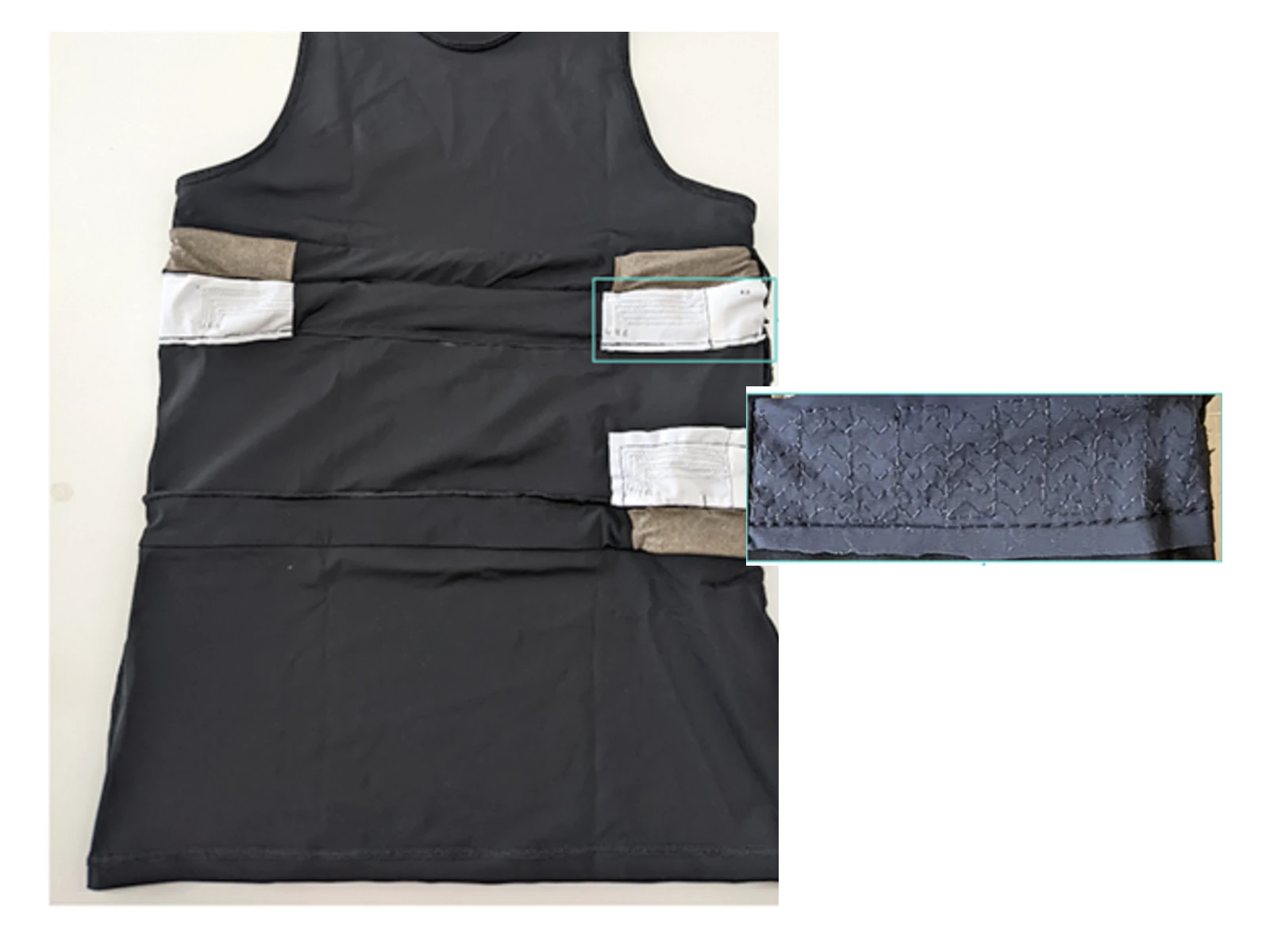
Sewn electrodes and signal wires that keep working through the wash
A garment electrode has to keep its signal quality when the wearer moves and after the shirt goes through the wash. In a Rice University study of three subjects, electrodes sewn from carbon nanotube thread (15 cm or more of thread per electrode) gave EKG signal quality that did not differ significantly from commercial adhesive electrodes. After 10 machine washes with oven drying, the sewn electrodes kept a signal quality comparable to commercial electrodes, while cotton thread coated with carbon ink degraded. Stretched to about 60% strain more than 1,000 times, they showed no discernible change in signal quality.
Carbon is the new black: Galvorn’s multi-property advantage delivers multi-functional garments.
Cut resistance
Cut resistance, measured on single fibers
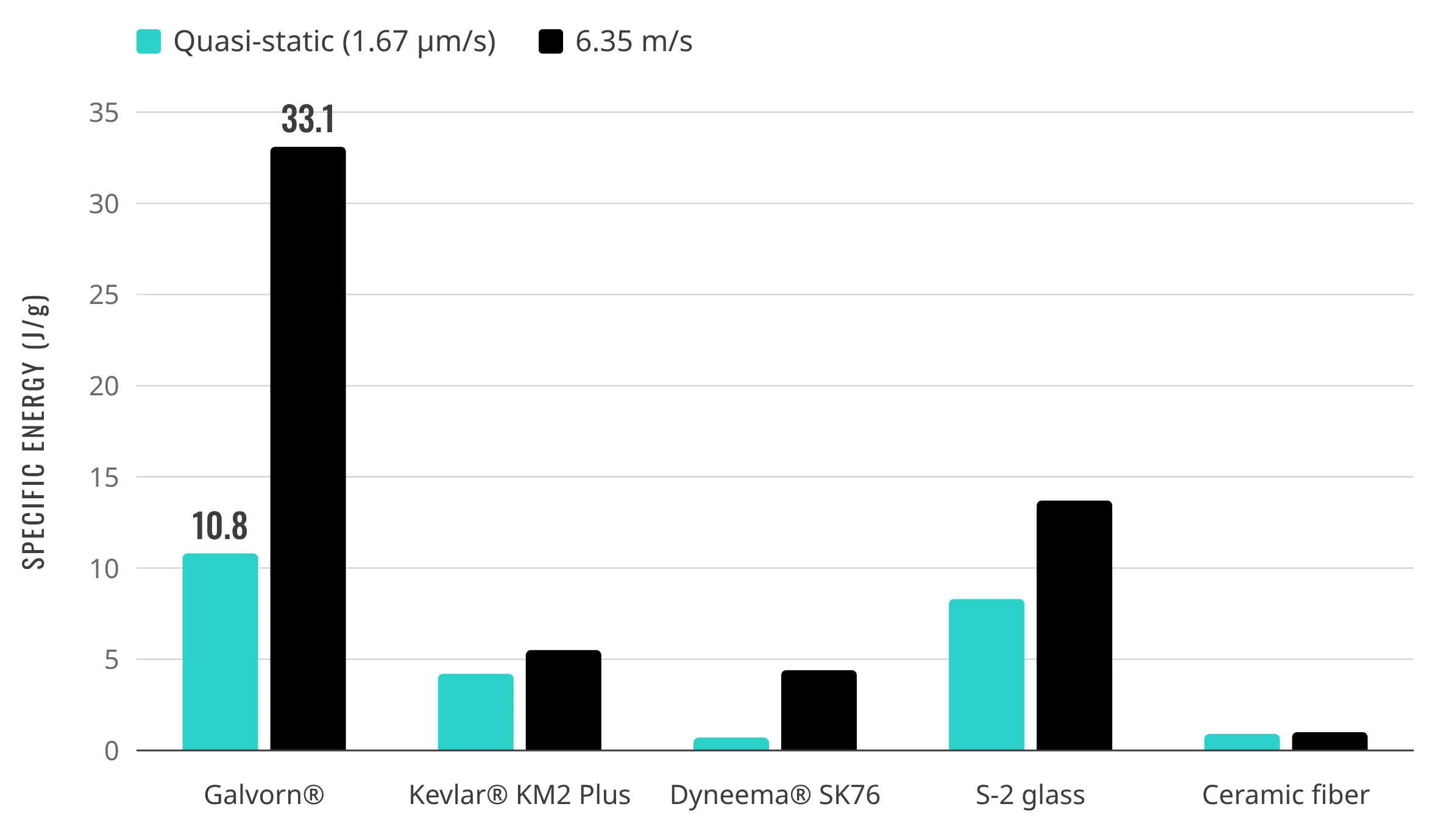
Glove makers and protective-gear developers need a fiber that survives a blade. In blade-loading tests on single fibers at 6.35 m/s, Galvorn absorbed more than 2.4 times the energy per unit mass of other commercial high-performance fibers. The fibers compared were Kevlar® KM2 Plus aramid, Dyneema® SK76 polyethylene, S-2 glass, and a ceramic fiber.
A 2019 Rice University study of carbon nanotube fibers found they become significantly stronger under rapid, high-force impacts.
Third-party test
807gf
ANSI/ISEA 105 cut level A2, ASTM F2992-15, accredited lab
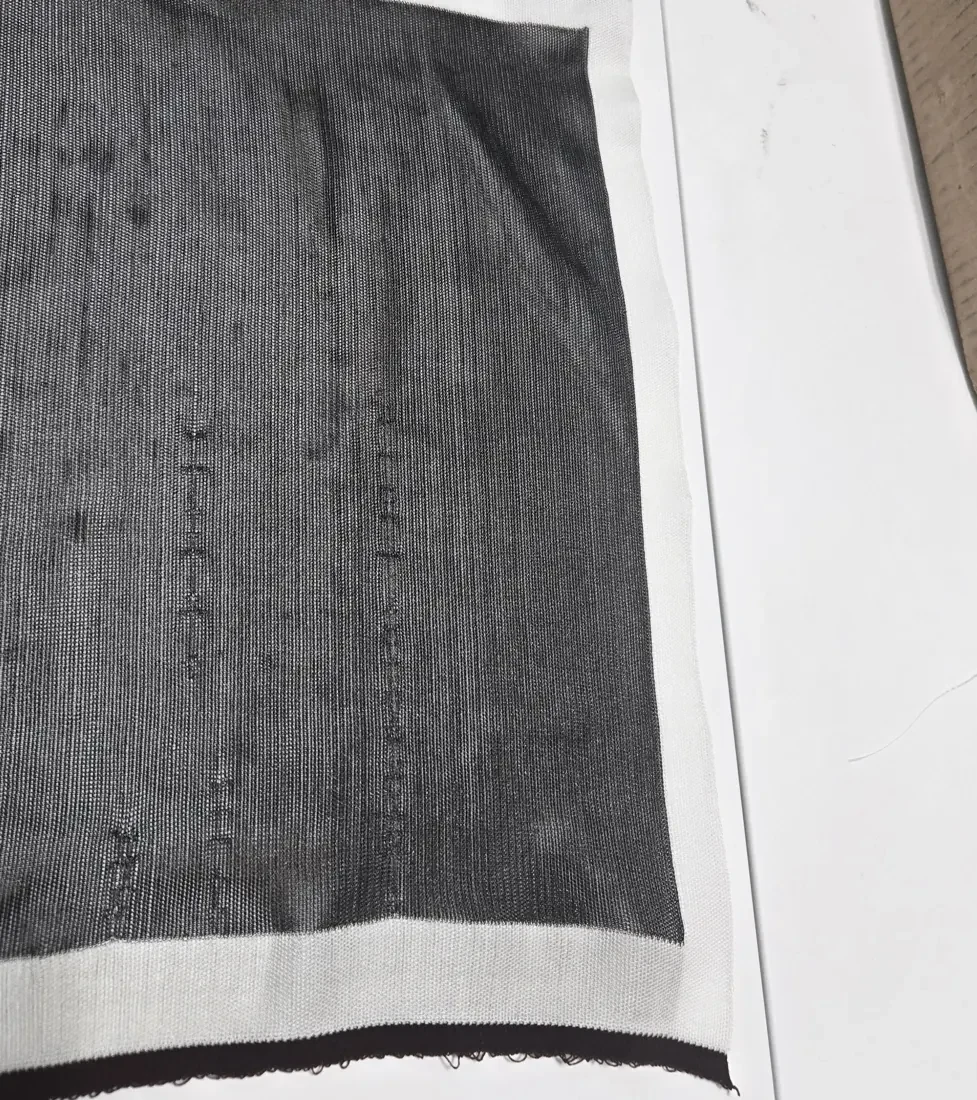
A 100% Galvorn knit reached ANSI cut level A2.
A 200 g/m² (5.9 oz/yd²) open knit of 100% Galvorn reached ANSI level A2 in third-party cut testing. In this test a weighted razor blade is drawn across the fabric, and the gram-force (gf) rating is the load it takes to cut through in 20 mm of travel, so a higher number is harder to cut.
A published NASA study recorded 742 gf for a Vectran cut-resistant glove knit 17% heavier (234 g/m²) under a comparable TDM method (Jones et al., ICES-2024-52, 2024); Vectran is a liquid crystal polymer fiber in the same class as Kevlar, chosen by glove makers for cut resistance. Per unit weight the Galvorn knit scored about 27% higher, from a construction that had not been engineered for cut performance.
Dust repelling
Sewn electrodes that shed lunar dust
Spacesuits, inflatable habitats, and other flexible surfaces in space collect dust that abrades the fabric, and the copper electrodes used to repel dust from rigid surfaces fatigue once a fabric flexes. In a study at NASA Kennedy Space Center, carbon nanotube yarn made at Rice University was sewn into spacesuit outer fabric as the electrodes of an active dust-repelling system. Energized with a multi-phase AC voltage, the fabric repelled more than 80% of lunar dust simulant, on par with or better than copper magnet wire, and the flexible yarn conformed to the weave where the rigid copper wire did not.
Compared with metal threads
Conductivity, flex life, and durability, with the basis for each
A garment thread carries signal while the wearer moves, so its resistance sets how much signal reaches the sensor. Next to the conductive threads in many smart garments, Galvorn has lower resistance than silver-coated nylon thread. Against steel, Galvorn fiber at its best is about 15 times as conductive weight for weight (6,150 vs 400 S·m²/kg) and about 3 times as conductive by volume (10 vs 3.4 MS/m), compared with solid steel wire.
A thread bends every time the wearer moves, so flex life decides how long it keeps working. Galvorn has 1,000x the flex life of copper. In bending fatigue tests at Rice University, a fiber of this material survived more than a billion bending cycles without breaking. Copper wire in the same test rig failed before one million. In DexMat’s overhand knot test, Galvorn fiber kept 70% of its tensile strength with the knot tied in it, while bundles from a 24K carbon fiber tow kept 1.5% to 3% in the same test. Textiles also meet moisture, washing, and heat. Galvorn is carbon, so it does not rust or pit, and it does not melt and resists flame.
Who it is for
For teams that build textiles that conduct, sense, and protect.
Galvorn is for textile mills, glove and apparel makers, protective-gear developers, and smart-garment and wearable teams working where conductivity, cut resistance, or light weight decide the design. DexMat supplies the yarn, fabric, and other forms, and you build the finished textile on your own equipment.
FAQ
Questions engineers ask about Galvorn for advanced textiles.
Yes. Galvorn yarn can be knitted, woven, sewn, or embroidered on standard textile equipment. DexMat has run its yarns on an industrial embroidery head, and yarn near 200 microns suits small embroidery needles. Tell us your machine and needle size and we’ll suggest a yarn.
Test Galvorn on your own equipment
Order yarn or fabric samples, or tell our engineers what you’re building.