
Industries / Aerospace & space
Lighter wiring and shielding for aircraft and spacecraft with Galvorn®
Galvorn advanced carbon material makes harnesses, cable shields, and heat paths lighter, stronger, and built to flex.
Context
Which materials are used for aerospace and space wiring and shielding?
Aerospace and space wiring runs on metal: copper or copper alloy conductors for signal and power, copper braid for cable shields, and copper or aluminum for heat straps. Every kilogram of it rides along for the life of the vehicle, so harness designers trade conductivity against mass, bend radius, and flex life at every connector and hinge. Galvorn® is an advanced carbon material that carries current and heat and handles like a textile, so it replaces metal where mass, strength, and flex life decide the design. DexMat supplies the material, and your harness or cable maker builds the finished part.
As fiber, Galvorn is 97% as conductive as copper weight for weight and 80% less dense (1.6 vs 9.0 g/cm³). It comes as twisted yarn, braided yarn, fabric, and film, and each suits a different part of the vehicle, from signal wire to cable shields.
The problem
Every gram of wiring and shielding rides with the vehicle.
On satellites, launch vehicles, UAVs, and eVTOL aircraft, mass sets payload, range, and launch cost. Wired signal harnesses alone can account for up to 10% of a satellite’s dry mass, according to an EU-funded project description. A published Aerospace Corporation article reported that every kilogram saved in the spacecraft bus or instruments represented a possible saving of up to five kilograms in launch, propulsion, and attitude-control mass. Galvorn weighs less than a fifth as much as copper for the same volume, so signal wiring, cable shields, and heat paths can carry less mass.
Galvorn at a glance
The figures that matter most for aerospace and space.
These are the figures that matter most for aerospace and space. Each one comes from the data sheet or a named test program, and the data sheet gives the specification for each grade and form.
Signal wiring and harnesses
Lighter signal wire for harnesses on aircraft and spacecraft.
Signal and data wiring runs through every vehicle, and many of those circuits carry little current. Galvorn® Twisted Yarn and Galvorn® Braided Yarn suit these circuits as lighter, stronger conductors. In customer testing, Galvorn carried about 3x as much current as copper, weight for weight, and every one of the ten Galvorn constructions tested carried more current per gram than 24 AWG solid copper wire, from 1.4x to 6.2x, calculated from the customer’s measured currents and Galvorn product specifications.

EMI shielding
Lighter cable shields that held up in NASA-funded testing.
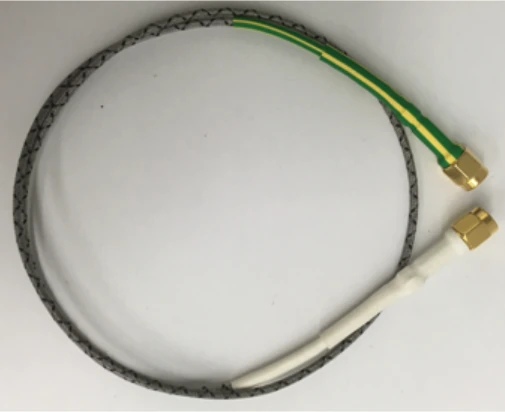
Spacecraft and avionics cabling is shielded against electromagnetic interference (EMI), usually with a metal braid. NASA funded three SBIR projects on lightweight shielded cable and wiring for space systems. In that work, an early Galvorn film shield came in about 95% lighter than the double metal braid it replaced, and prototype RG 316 coax wrapped with it met the military specification for insertion loss, and its shielding effectiveness matched a commercial cable with a double silver-plated copper braid, with no measurable loss after 1,000 flex cycles at a 0.83 cm bend radius. Today DexMat customers are developing Galvorn-based EMI shielded cable to suit their specific needs.
Sleeves and overbraid
Customers are evaluating Galvorn overbraid for harness bundles.
Harness bundles are often covered with a metal overbraid. DexMat customers are also evaluating Galvorn braided sleeves and overbraids on harness bundles as a lighter alternative to metal overbraid.
Heat paths
Move heat with less mass.
Payload electronics and sensors reject heat through straps, spreaders, and radiators, and each one adds mass. At the single-filament level, Galvorn is 17% more thermally conductive than copper (450 vs 385 W/m-K), at 1.6 g/cm³ against copper’s 9.0. In a published Rice University study of annealed film made by DexMat, heat moved at about 270 W/m-K along the alignment, and about 1,400 times better along the film than through its thickness. That directionality is the point: film can be laid to move heat along a chosen path while limiting it across another, which copper, conducting the same in every direction, cannot do. Galvorn film and yarn are candidates for flexible thermal straps; strap performance has not been measured.
Composites
Composites that do more than carry load.
Carbon fiber composites give aircraft and spacecraft strength at low weight, but carbon fiber’s electrical conductivity is negligible, so teams add metal mesh for shielding, separate sensors for damage, heat spreaders, and wiring, and each one costs weight and another bond line. Galvorn goes into the layup alongside carbon fiber and takes on several of those jobs with one material. Galvorn® Fabric and Galvorn® F10 Film form conductive layers that carry current or shield electronics. Galvorn yarn is piezoresistive, and customers are evaluating it embedded in a composite so the part can report its own condition without a separate sensor. Customers sew Galvorn thread through carbon fiber to reinforce the laminate through its thickness. A single Galvorn filament conducts heat better than copper at less than a fifth of the weight for the same volume. And because Galvorn is flexible rather than brittle, composites built with it are expected to fail less suddenly than carbon fiber: in DexMat’s overhand knot test, Galvorn fiber kept 70% of its tensile strength, while bundles from a 24K carbon fiber tow kept 1.5% to 3%.
Forms and who builds with them
Choose a form, then build with our partners or yours.
Galvorn comes as twisted yarn, braided yarn, fabric, and film. Galvorn can be run on wire and cable manufacturing equipment, including extrusion, and it can be knitted, woven, or embroidered using standard textile equipment. The film wraps on commercial tape-forming equipment, as in the NASA-funded prototype cables. DexMat supplies the material, and you build the finished harness, cable, or part with your own manufacturing partner or with DexMat and one of its cable-making partners.
| Form | Typical use in aerospace and space |
|---|---|
| Galvorn® 1000 Twisted Yarn, Galvorn® 800 Twisted Yarn | Signal and data wire, lightweight conductors |
| Galvorn® 1000 Braided Yarn | Current-carrying conductors up to 5 Amps |
| Galvorn® F10 Film | Shielding layers, conformal conductive elements, and directional heat spreading |
Who it is for
For programs where mass is the budget.
Galvorn is for spacecraft and satellite builders, launch vehicle teams, eVTOL and aircraft programs, UAV platforms, and the harness and cable manufacturers that supply them. It fits where weight, flexibility, and service life decide the design. For military platforms, see Defense.
FAQ
Questions engineers ask about Galvorn in aerospace and space.
In signal and data wire that is sized by strength, flex life, or available room, and in the cable shield. A Galvorn conductor sized to match a copper conductor’s resistance weighs within a few percent of the copper, because Galvorn fiber is 80% less dense and 97% as conductive weight for weight. Wherever strength, flex life, or available room sets the conductor size instead, the weight savings follow, and a film shield about 95% lighter than a double metal braid is projected to cut cable weight by about 50% in NASA-funded testing.
Start with a sample.
Order sample quantities of any Galvorn form from the store, download the data sheet for full specifications, or talk with our engineers about your harness, shield, or thermal path.