
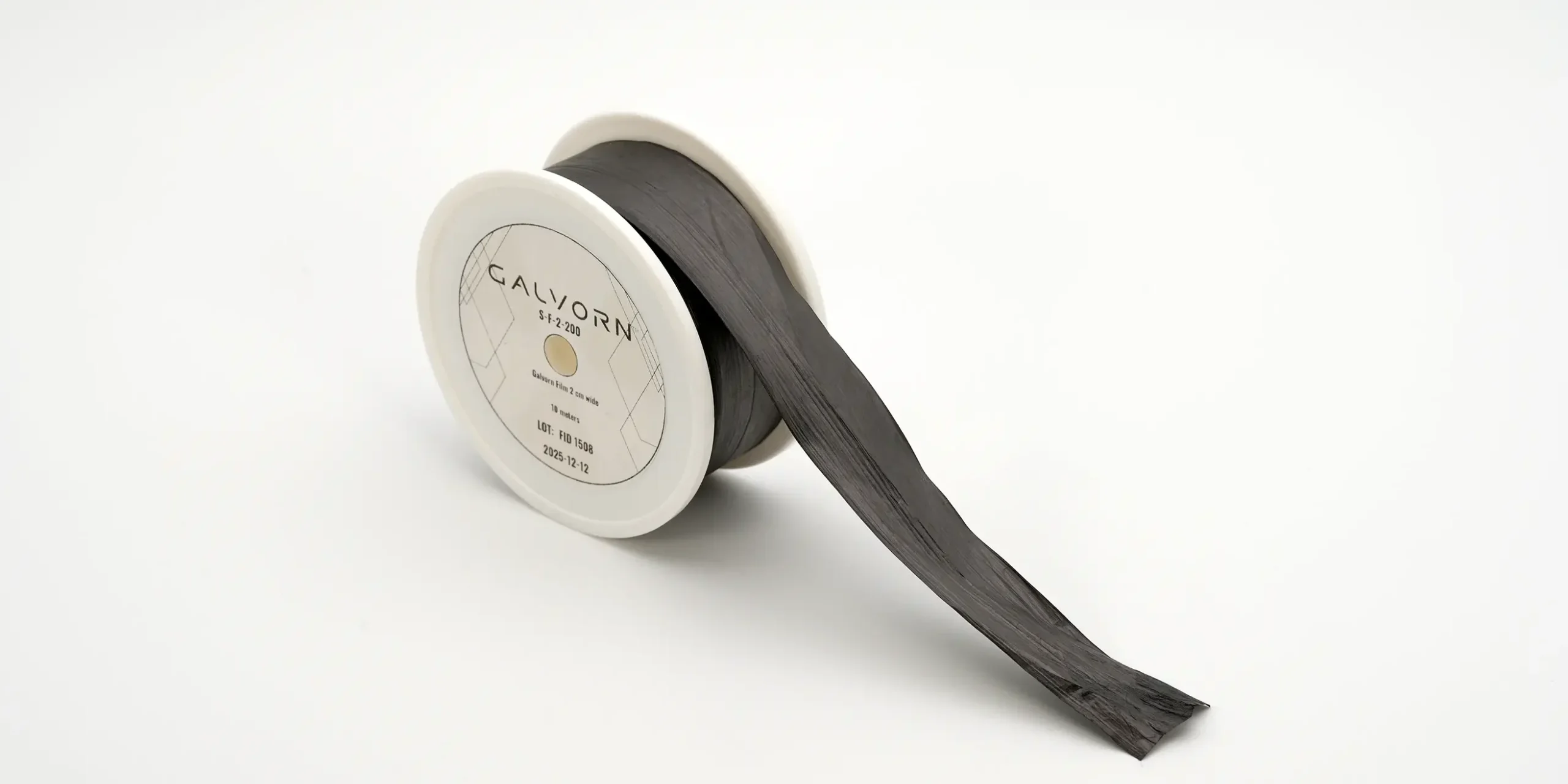
Galvorn® is an advanced carbon material with thermoelectric properties. Specifically, it generates a voltage from a temperature difference, a property called the Seebeck effect. This piece looks at what that property is good for, which thermoelectric applications actually depend on it, and what independent testing on Galvorn® F10 Film shows about how anneal temperature changes the film's thermoelectric power factor, the metric that determines how much usable power the effect can deliver.
While this piece focuses on the properties and behavior of F10 Film, Galvorn is produced in a variety of form factors: fiber, yarn/wire, film, and fabric. In contrast to rigid ceramic thermoelectric materials, Galvorn is lightweight and flexible, letting designers put both the thermoelectric response and the material's physical form to work.
In brief
- Thermoelectric materials convert heat and electricity into each other directly, with no moving parts; thermoelectric power factor is what determines how much usable power or signal a material can produce from that effect.
- For energy harvesting from an unlimited heat source and for active cooling through the Peltier effect, power factor, not the full ZT figure of merit, is the metric that matters most.
- F10 Film's power factor rises with anneal temperature, from 1.35 to 5.25 milliwatts per meter-kelvin squared, a 3.9x increase, in a material that's already lightweight and flexible enough to take shapes rigid ceramic thermoelectrics can't.
What do thermoelectric materials do, and why do they matter?
Thermoelectric materials convert heat and electricity into each other directly, with no moving parts and nothing to maintain. A temperature difference across the material produces a voltage through the Seebeck effect, and running a current through the material moves heat from one side to the other through the related Peltier effect. That matters because most of the heat generated in industrial processes, electronics, and machinery today goes to waste, and a solid-state material that turns a temperature difference into usable electrical signal or power has real value wherever reliability matters more than raw efficiency, or wherever the material has to reach a place a bulky mechanical system can't.
What types of thermoelectric applications exist?
Three application types rely on this behavior.
Energy Harvesting
Energy harvesting captures otherwise wasted heat, from industrial equipment, automotive exhaust, or solar heat, and converts it into usable electricity.

Temperature Sensing
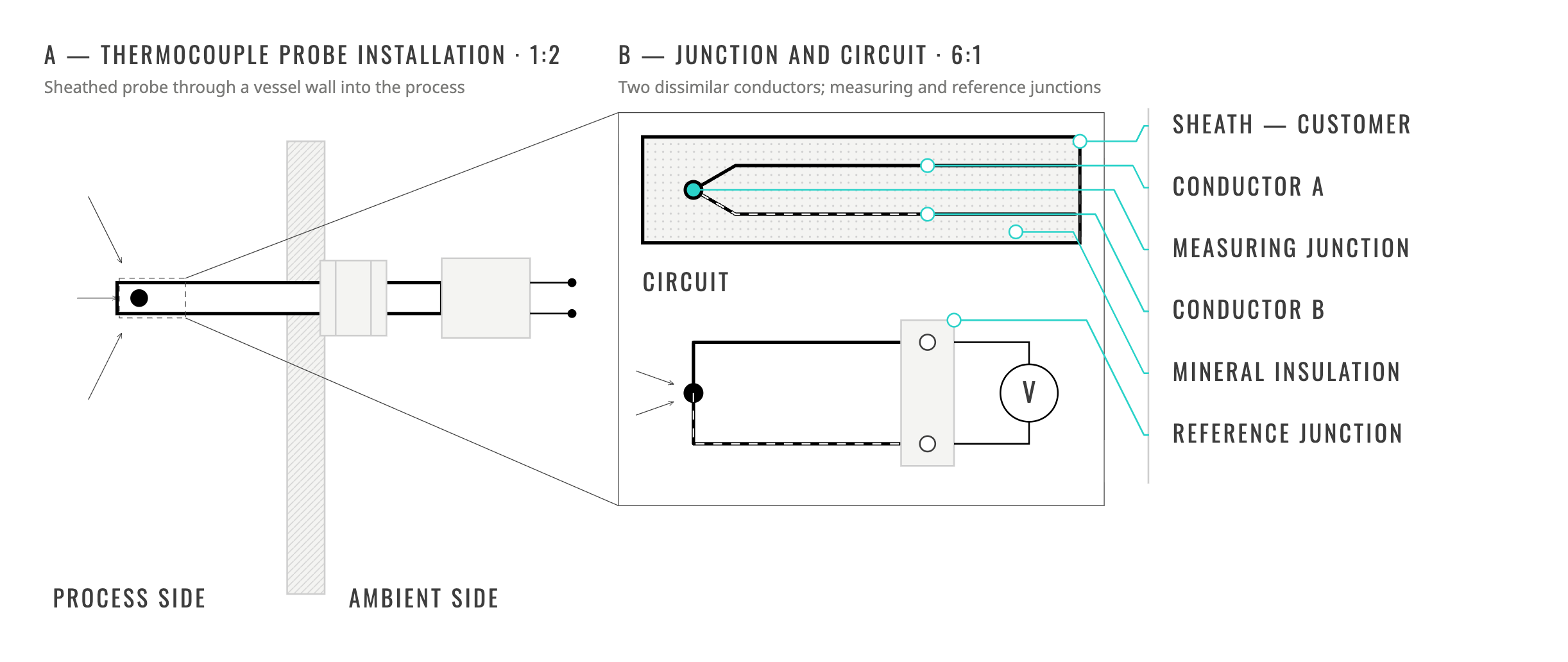
Temperature sensing uses the Seebeck voltage directly: a thermocouple is two dissimilar conductors generating a voltage proportional to a temperature difference, used wherever temperature needs measuring without powering the sensor itself.
Solid-State Cooling
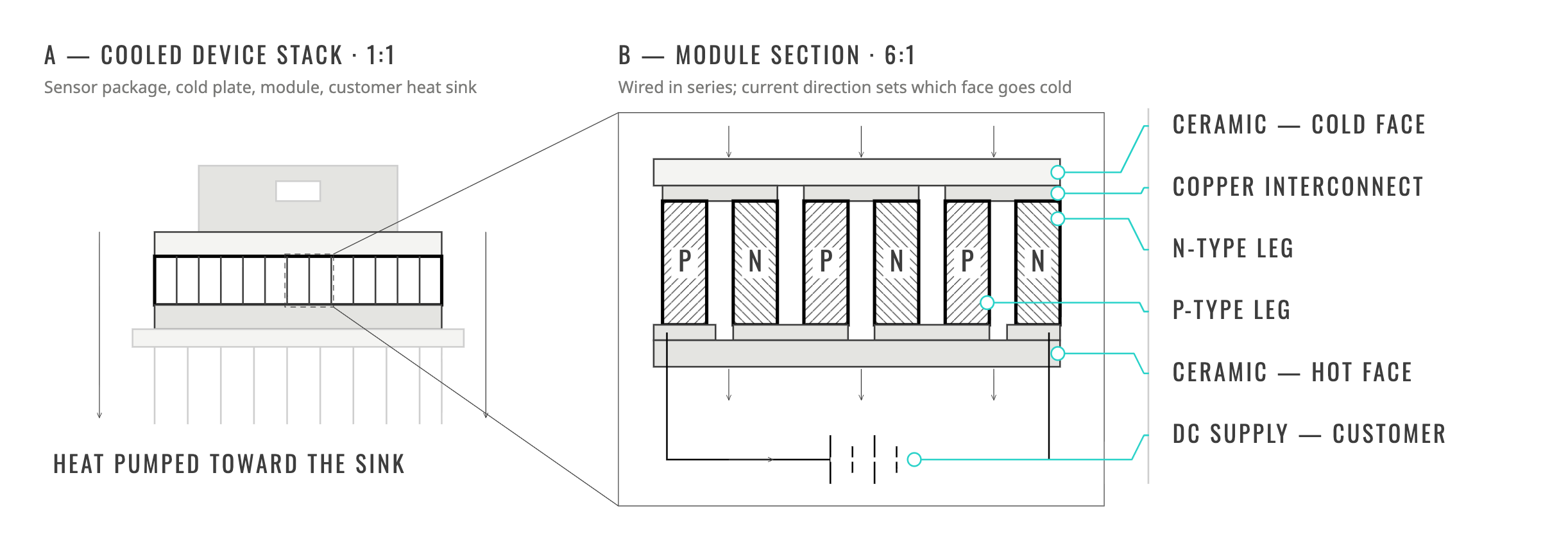
Solid-state cooling runs the same physics in reverse through the Peltier effect, pumping heat without moving parts.
Which of these applications benefit specifically from a large thermoelectric power factor?
Not every thermoelectric application is optimized the same way. The full thermoelectric figure of merit, ZT, factors in thermal conductivity alongside power factor (ZT = S²σT/κ), and for many applications a lower thermal conductivity is what makes ZT go up.
Published research on carbon nanotube fiber thermoelectrics argues that thermoelectric power factor, not ZT, is the more relevant metric in two specific cases. For energy harvesting from an effectively unlimited heat source, like industrial waste heat or solar heat, output power density scales directly with power factor. For active cooling through the Peltier effect, the physics wants a large power factor and a large thermal conductivity at the same time, the opposite of what ZT optimization usually pushes toward.
A 2021 Nature Communications paper on carbon nanotube fibers makes this case directly, reporting a fiber with a Seebeck coefficient of 68 microvolts per kelvin, a power factor of 14 ± 5 milliwatts per meter-kelvin squared, and a thermal conductivity of 580 watts per meter-kelvin, a combination they argue no other thermoelectric material achieves at once. F10 Film doesn’t reach that number, but at 5.25 mW/m·K² after a 500°C anneal (see the table below), it’s still among the highest power factors reported for any material in a flexible film that can be manufactured and sold today. Few materials post power factors like this, and fewer still do it while conforming to a curved surface or wrapping a pipe. Energy harvesting from an unlimited heat source and active cooling through the Peltier effect are the two applications F10 Film’s power factor data below speaks to directly.
How does F10 Film perform on thermoelectric power factor?
Both of these application types also tend to need the thermoelectric material to physically conform to a real surface: wrap a pipe, line a housing, follow a curved or moving part, and that's exactly where rigid ceramic thermoelectrics run into a limit, since they crack under bending. F10 Film's flexibility is what makes its thermoelectric behavior worth examining in the first place.
F10 Film generates a voltage across a temperature difference, measured by the Seebeck coefficient in microvolts per kelvin. Thermoelectric power factor goes a step further: it's the Seebeck coefficient squared, multiplied by electrical conductivity (PF = S²σ), and it captures how much electrical power a material can deliver, not just how much voltage it generates.
The F10 Film was tested under three post-spin conditions: as-spun with no additional heat treatment, annealed at 300°C, and annealed at 500°C. Our customer measured the Seebeck coefficient on each sample, and Rice University measured thermal conductivity.
| Condition | Resistivity (µΩ·cm) | Conductivity (MS/m) | Seebeck coefficient (µV/K) | Power factor (mW/m·K²) | ZT at 300K |
|---|---|---|---|---|---|
| As-spun | 24.6 | 4.07 | 18.2 | 1.35 | 0.0015 |
| 300°C anneal | 47.6 | 2.10 | 29.1 | 1.78 | 0.0020 |
| 500°C anneal | 60.0 | 1.67 | 56.1 | 5.25 | 0.0058 |
Thermoelectric power factor rises at every step, not just from end to end. Resistivity climbs as anneal temperature increases, cutting electrical conductivity by more than half from as-spun to 500°C, but the Seebeck coefficient more than triples over the same range, and since power factor depends on Seebeck coefficient squared, that gain outpaces the conductivity loss at each anneal condition.
What does the low ZT mean, and why isn't that the whole story?
F10 Film's ZT, in the thousandths, is two to three orders of magnitude below bismuth telluride's roughly 1.2, the standard commercial thermoelectric material. That gap means F10 Film isn't positioned to replace dedicated thermoelectric ceramics where bulk conversion efficiency is what matters.
The more relevant story is a real, tunable, rising thermoelectric power factor that comes packaged with a material that's already a strong electrical conductor in a flexible, lightweight film, not a separate, single-purpose thermoelectric material. That combination, meaningful power factor alongside high electrical conductivity and a form factor rigid ceramics can't take, is exactly what published carbon nanotube fiber research points to as the useful profile for energy harvesting and active cooling applications, distinct from the low-thermal-conductivity profile that makes ceramics efficient at bulk power generation.
Frequently asked questions
If you're evaluating F10 Film's thermoelectric properties for your application, contact DexMat's engineering team.