
Applications / Multifunctional composites
With Galvorn®, composites do more than carry load.
Galvorn is an advanced carbon material with a multi-property advantage, combining conductivity with lightweight strength and textile-like flexibility. In composites that means one material can carry current, move heat, sense damage, and reinforce a composite part, all without a density tax.
Context
What are multifunctional composites?
Multifunctional composites conduct current, move heat, sense their own condition, or reinforce the laminate. Designers are asking composites to do more than carry load, and composites suppliers describe multifunctionality as one of the biggest shifts in the field, with embedded sensing and structural health monitoring among the functions in demand. The appeal is practical: every sensor, wire, and shield added to a part costs space and weight, and a layer that does more than one job saves on both. Galvorn® is an advanced carbon material supplied as fiber, yarn, fabric, and film, so a single layer can take on those jobs. It handles like a textile, or like ribbon in the case of film, so composite teams can work with equipment they already run.
The problem
Every added function usually adds another part.
Carbon fiber composites give aircraft, launch vehicles, and cars strength at low weight. But its electrical conductivity is negligible. So teams add metal mesh for lightning current and shielding, separate sensors for damage, heat spreaders, and wiring. Each addition costs weight and another bond line in the structure.
With Galvorn in the layup, the stack of material layers that forms the part, one material can take on several of those jobs.
Properties
A lighter, stronger, and more flexible conductive material
Top-line figures are Galvorn fiber values. Product-grade specifications are in the data sheet.
Conductive layers
Put the conductor in the layup.
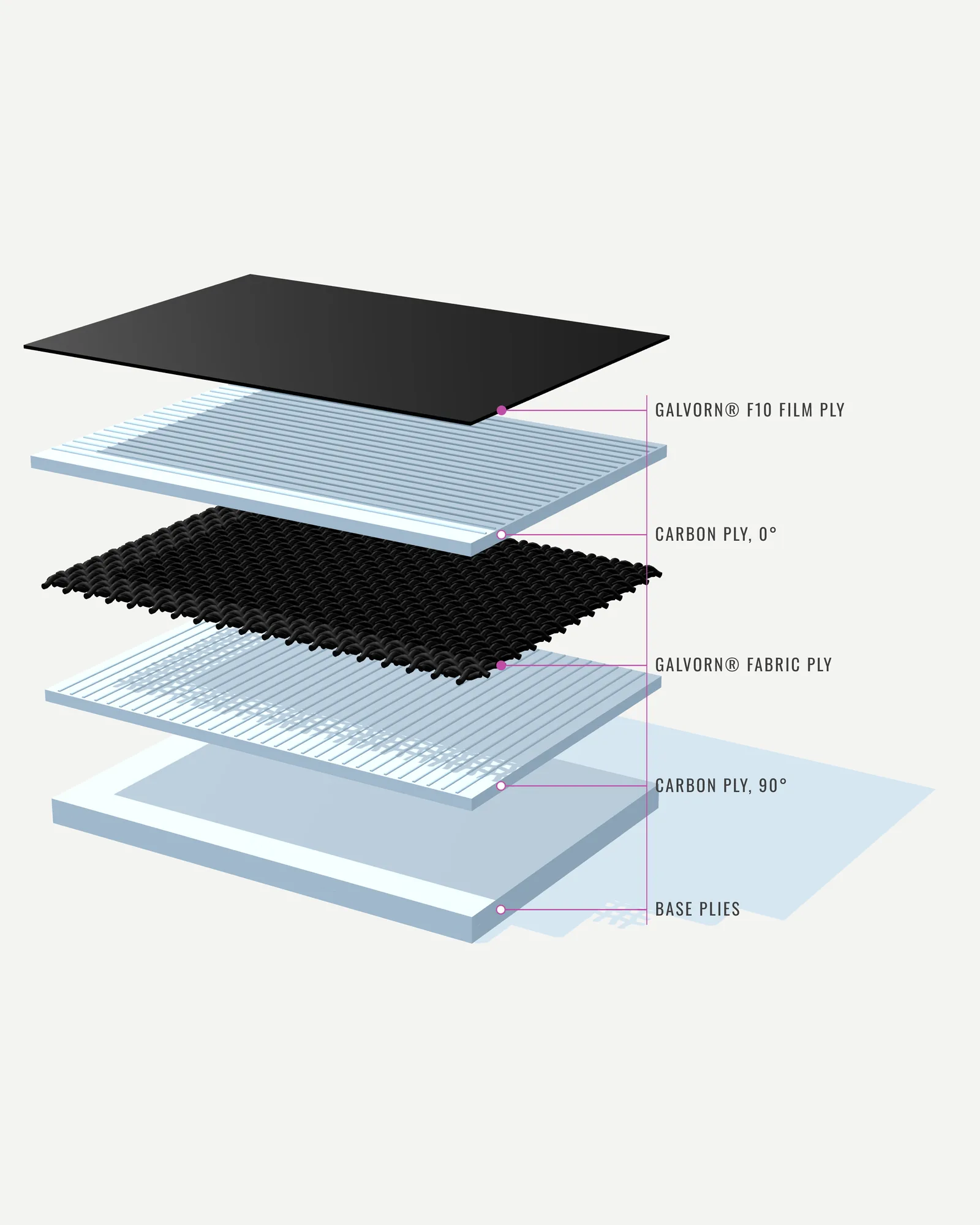
Spacecraft, aircraft, and vehicles are running out of room for sensors and wires. Each added conductor costs space and weight. A conductive layer can carry current, shield electronics, or give lightning current a path through the skin of a part, depending on your layup and threat level. Galvorn® Fabric can be composited and with its superior flexibility is expected to more easily conform to complex geometries and composite molds. Galvorn® F10 Film can be integrated into a composite or applied as a conductive surface layer. Because Galvorn conducts current and lays up like a textile, wiring and sensor leads could also run inside the composite itself instead of alongside it.
Integrated sensing
The structure is the sensor.
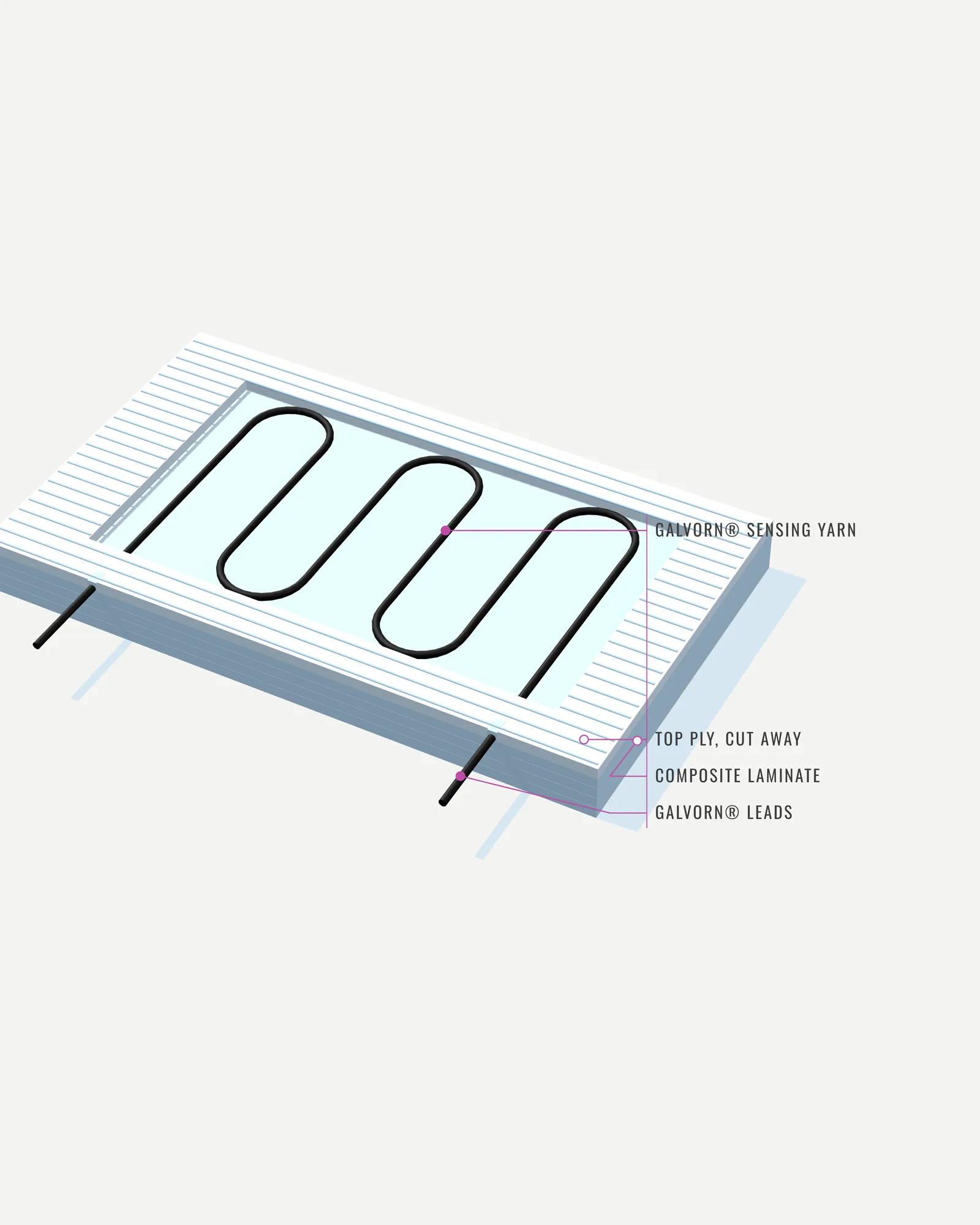
Damage in a composite, from pressure, compression, or strain, can be hard to see, so parts are inspected on a schedule or fitted with separate sensors that add weight, wiring, and another bond line. Piezoresistive materials offer another route: their electrical resistance changes under load, which turns the material itself into the sensor. Galvorn yarn is piezoresistive, and customers embed it in composites so the part can report on its own condition without a separate sensor bonded on. The signal depends on the yarn, the layup, and the load path, so test it in coupons of your own layup.
Reinforcement
Reinforce a laminate through its thickness.
In a laminate, resin alone typically holds the layers together, so impact and shear can peel them apart, a failure called delamination. Customers sew Galvorn thread through carbon fiber laminates to reinforce them in the z-direction, i.e. the direction through the thickness. With Galvorn, the same thread that can detect delamination, mitigates it.
Where a part needs the peak strength and stiffness of high-end carbon fiber, about 6.4 GPa tensile strength against 3 GPa for Galvorn fiber, Galvorn goes into the layup alongside it for the extra functions; where the part is sized by conductivity, weight, or flexibility instead, Galvorn can take a larger share of the layup.
Handling
Weave, braid, or stitch it on standard equipment.
Preforms for composites are built on textile equipment, including looms, braiders, and embroidery machines. Galvorn handles like a textile, so fiber and yarn can be woven and braided on standard equipment, and it has about 1,000x the flex life of copper. In bending fatigue tests at Rice University, a fiber of this material survived more than a billion bending cycles without breaking. Copper wire in the same test rig failed before one million.
Yarn also runs through technical embroidery machines, including for tailored fiber placement, where the machine stitches yarn onto a dry fabric preform in the pattern the part needs before resin infusion. The placement head makes tight turns, which is where a flexible yarn helps.
Galvorn yarn on a technical embroidery machine at DexMat.
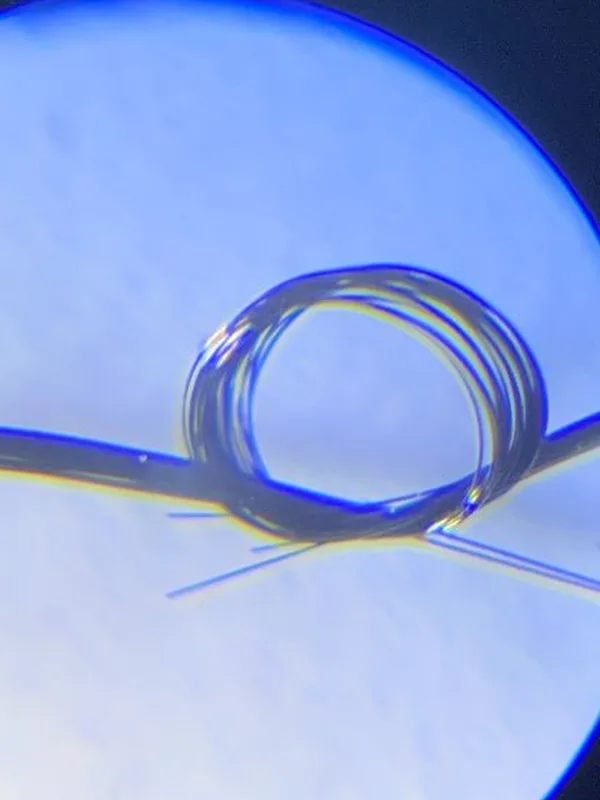
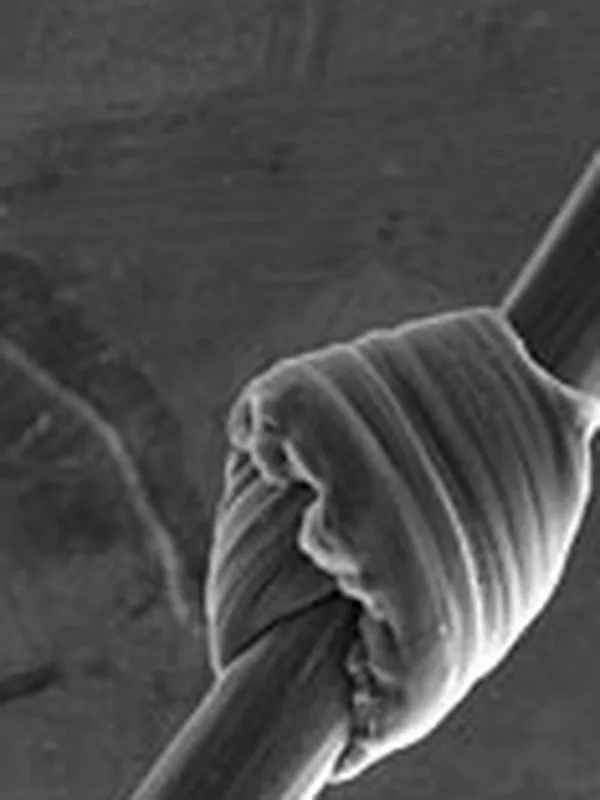
Overhand knot test, DexMat testing. Carbon fiber kept 1.5% to 3% of its tensile strength, Galvorn fiber kept 70%. Left: carbon fiber bundle, overhand knot; filaments break before the knot is fully tightened (DexMat). Right: a wet-spun fiber similar to Galvorn, overhand knot, no fraying or fracture (SEM image: Lee et al., Science Advances, 2022).
Durability
Flexible where carbon fiber is brittle.
Carbon fiber is strong but unforgiving: a tight bend or a sharp impact can break it suddenly. DexMat’s overhand knot test shows the difference. A knot forces a fiber through a tight bend that puts one side in compression and the other in tension, and in DexMat testing, carbon fiber bundles from a 24K tow with an overhand knot tied in them kept 1.5% to 3% of their tensile strength, while Galvorn fiber kept 70%. Because Galvorn is flexible rather than brittle, composites built with it are expected to be more durable and to fail less suddenly and catastrophically than carbon fiber.
Heat
Move heat through the structure.
Carbon fiber already moves heat through composite parts, at about 200 to 1,000 W/m-K depending on the fiber type. A single Galvorn filament conducts heat at 450 W/m-K, within that range, and conducts current about 100 times better than carbon fiber, fiber to fiber, so the same material can carry heat and current. Thermal composites, heat sinks, and heat sensing are covered on the Thermal Management page.
Recycling
Recyclable without losing properties.
Carbon fiber loses properties when it is recycled, so recovered carbon fiber is downcycled. Galvorn can be recycled from mixed material streams and spun into fiber again without losing properties, according to a 2025 study by Rice University researchers that included DexMat scientists.
Forms
Material from DexMat, composites from your team.
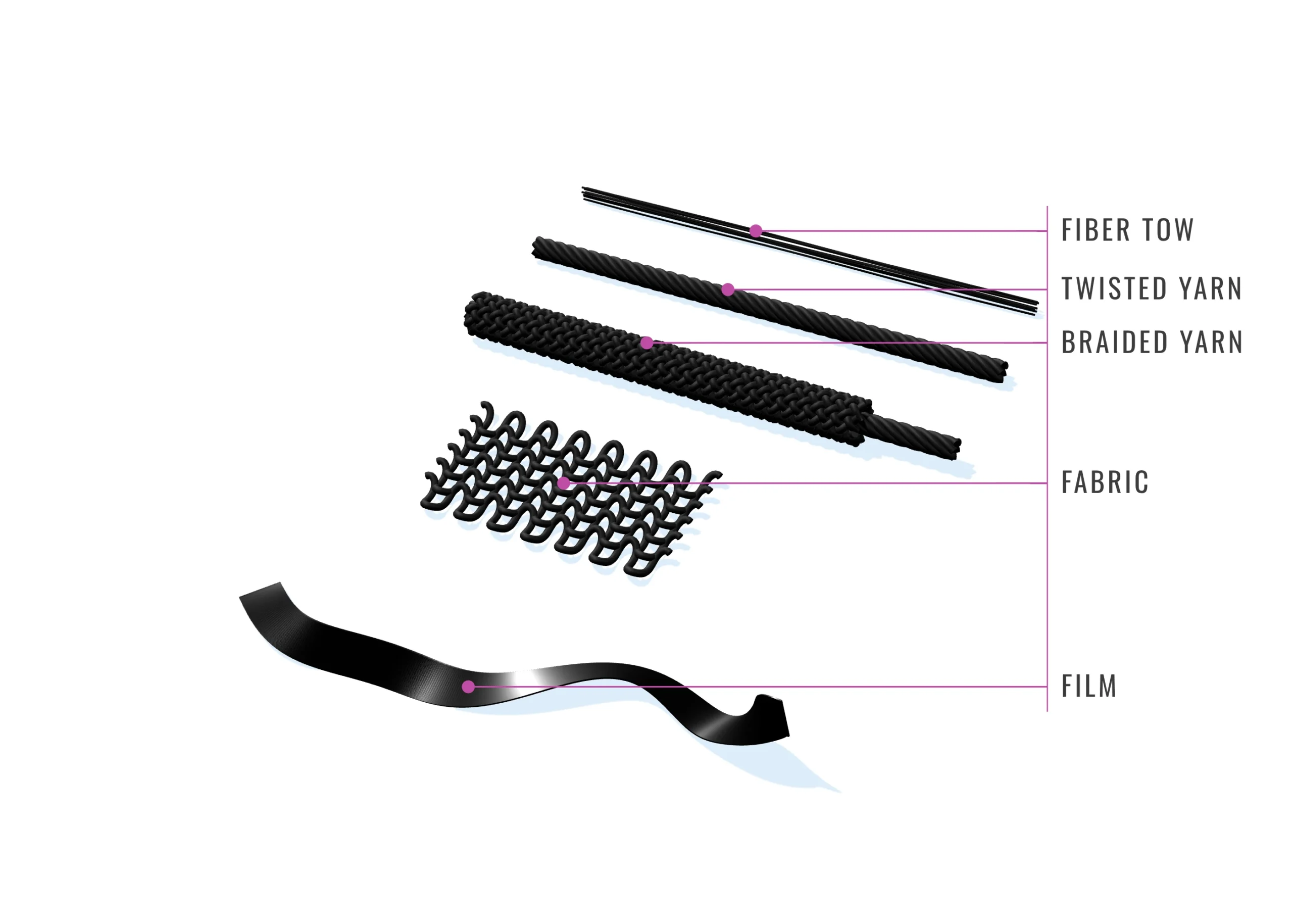
DexMat makes Galvorn in Houston, Texas, and ships it as fiber tow, twisted yarn, braided yarn, fabric, and film. Your team lays up, infuses, and cures the composite with your own resin systems. DexMat supplies the material and works with you on how to use it.
Research
Published work on the fibers.
A 2019 Rice University study, co-authored by DexMat co-founder Matteo Pasquali, found that the fibers become stronger under rapid, high-force impacts. A 2022 study of single fibers under blade loading, which used Galvorn fibers, found they absorb and spread more energy per unit mass than commercial high-performance fibers. Both are single-fiber results, not laminate tests, but they point at the question composite teams are asking us: whether a Galvorn layer that already carries current or senses strain could also help a part take sudden loads. Nobody has tested that at the composite level yet, so we treat it as a research direction rather than a spec.
Who it is for
For teams whose composites have to do more than carry load.
Composite designers and materials engineers use Galvorn where weight, conductivity, heat, or in-service monitoring drive the design: aircraft and UAV structures, launch vehicle and satellite components, vehicles, and sports equipment, along with university and technology-center groups developing the next layup.
FAQ
Questions engineers ask about Galvorn in composites.
It depends on what the application requires. High-end carbon fiber is stronger and stiffer, at about 6.4 GPa tensile strength against 3 GPa for Galvorn fiber. Today, customers are focused on using Galvorn to conduct current, move heat, and sense damage, and their designs use Galvorn alongside carbon fiber. For applications where the full tensile strength of carbon fiber is not required, customers expect Galvorn to be more durable and to fail less suddenly and catastrophically because it is more flexible, especially compared to brittle carbon fiber.
Start with a sample.
Order Galvorn Fabric, Fiber Tow, and Yarn samples from the store, or tell our engineers which function you want your composite to add.